

Bits of Being
The search for the nature of reality
Risk & Progress explores risk, human progress, and your potential. My mission is to educate, inspire, and invest in concepts that promote a better future for all. Subscriptions are free. Paid subscribers gain access to the full archive and Pathways of Progress.
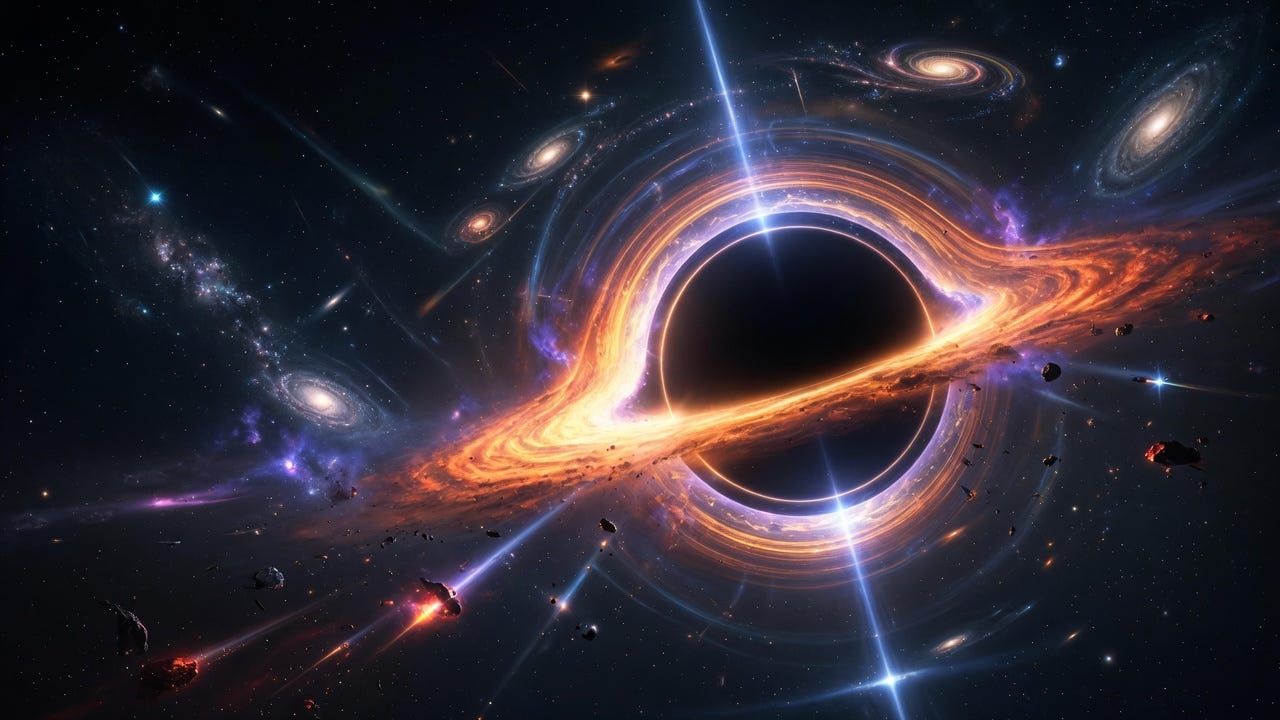
What if the entire universe, every star, every planet, and everything there ever was, exists inside a black hole? What if every historical event in your history textbook, or every memory you ever had, were merely code in someone else’s simulation? These possibilities are not fantasy; they are provocative ideas in modern cosmology, challenging everything we think we know about our origins, our fate, and the very nature of reality. Although the standard inflation/Big Bang model provides the best-supported account of the universe’s origin, it doesn’t address why anything exists at all, what triggered that initial spark, or what the universe really is. These fundamental questions remain open, and only we, as conscious observers, have the capacity to address them.
Before the Bang
What came before the Big Bang? What was the trigger? How could a singularity, a point in space that would literally break physics, exist in the first place? This is where science must once again give way to myth and philosophy. It’s where logic begins to twist around itself, and like matter entering a black hole, forms contradictions that appear impossible to resolve. For example, asking what happened before the Big Bang is, in a sense, kind of a silly question. The Big Bang is t=0; there is no “before”, time was created with the Big Bang. Arguably, therefore, there was never a time when nothing existed, so in that sense, the universe is eternal, yet it also still had a beginning. Make sense?
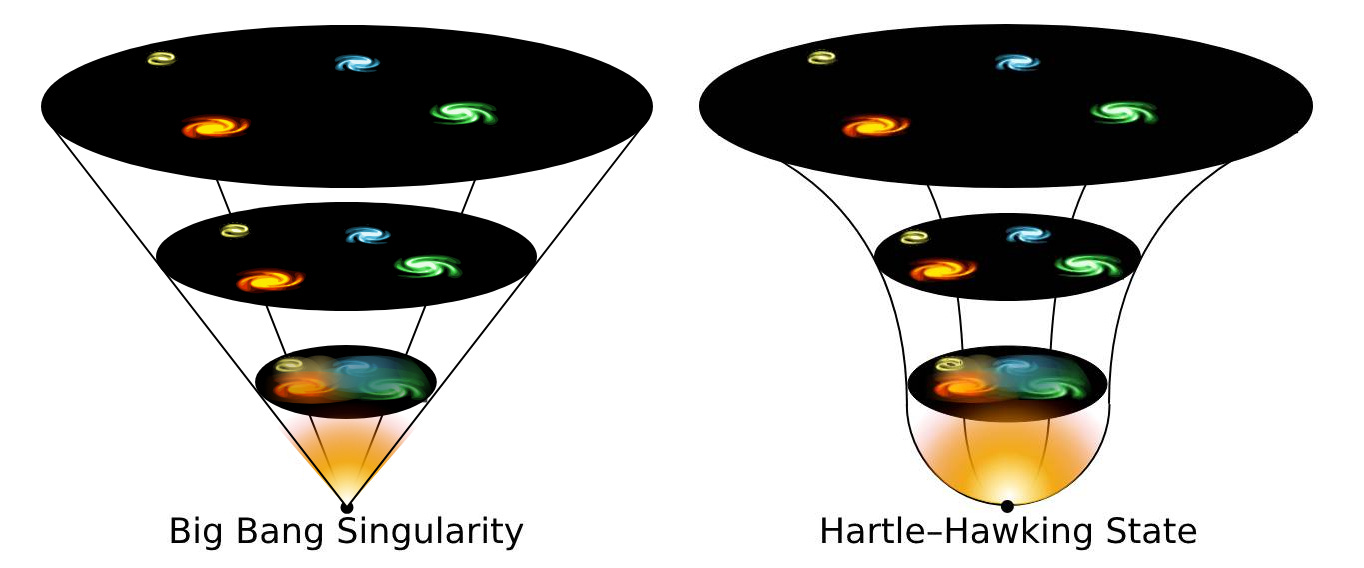
There is no shortage of theories attempting to explain these contradictions, to find the “trigger” of the Big Bang, and explain the mystery of the singularity. The Hartle-Hawking No-Boundary Proposal, for example, attempts to weave quantum mechanics into the universe’s origin story. It sidesteps the singularity problem by suggesting that there was no sharp beginning at all, just like there is nothing south of the South Pole; the smooth nature of the universe’s geometry would mean that there is no defining point at which everything began, yet it still had a beginning.
Some, like Russian-American theoretical physicist Andrei Linde, believe that our universe is just one “bubble” of countless many that form when random quantum fluctuations or tunneling events cause a local patch to drop into a lower-energy state. This, he argues, would trigger inflation and a Big Bang event. This results in a multiverse scenario and an ever-growing number of new bubble universes. In Why Does the World Exist? by Jim Holt, Linde explains that it doesn’t take much to create a new universe; with inflation, we need just a hundred thousandth of a gram of matter to create the vastness of the heavens. This also raises the possibility that our universe was created by intelligent beings living in another, the “child” universe expanding into itself, appearing as just an elementary particle in the parent.
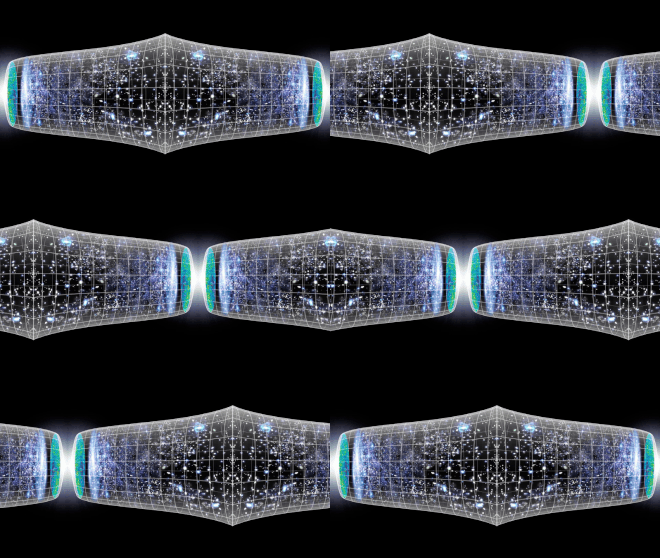
Another fan favorite is the “Big Bounce” model, which claims that our universe spawned, not from a singularity that randomly popped into existence, but from a “bounce” caused by the collapse of an earlier universe. In this model, the collapse of one universe gives rise to another in an endless cycle of destruction and rebirth. Curiously, a variant of this theory suggests that this is, in fact, the function of black holes. When a massive star collapses and forms a black hole, the interior doesn’t reach a singularity as assumed. Instead, the collapsing matter reaches a finite maximum density, and the spin of fermions (such as electrons and quarks) generates a repulsive force that rapidly expands on the “other side” of the event horizon, birthing a brand-new universe.
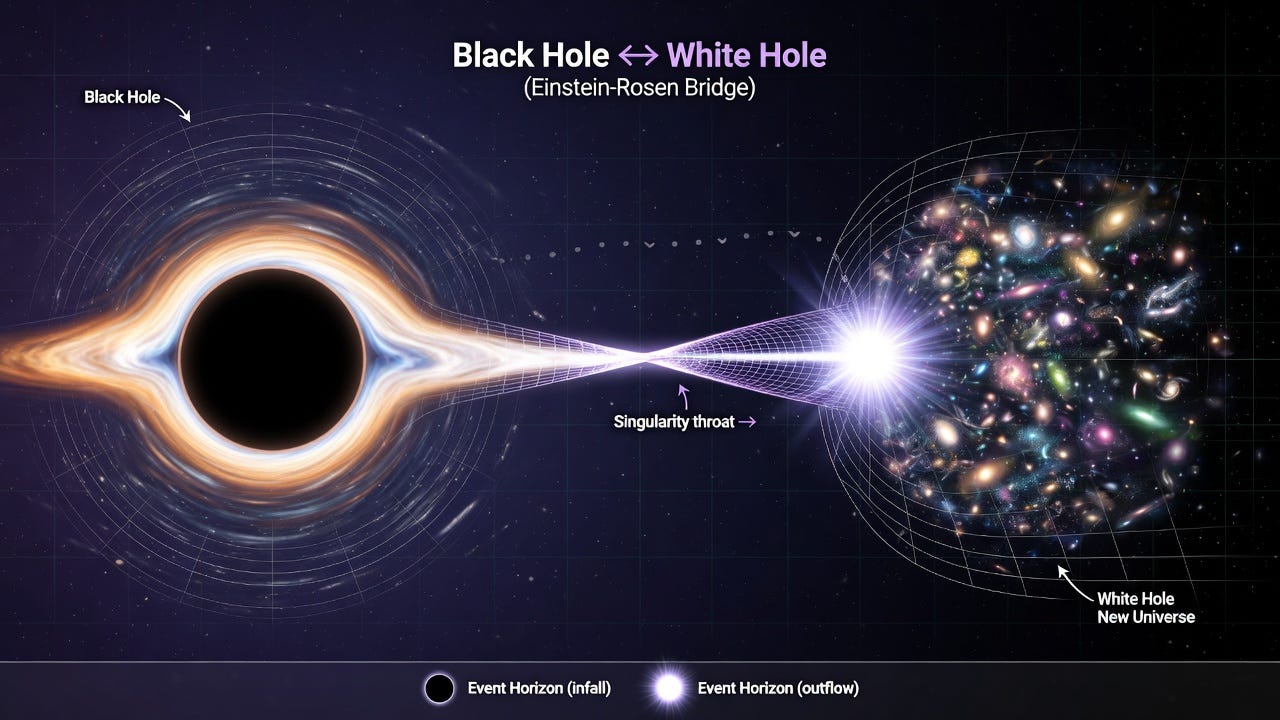
This theory is elegant, for it resolves both the singularities of the Big Bang and Black Holes using the same physics. Indeed, new images taken by the James Webb Space Telescope in 2025 suggest that the universe may have a preferred direction of rotation, with two-thirds of studied galaxies rotating in one direction and one-third in the other. Though far from dispositive, these findings raise the possibility that the universe began with rotation, and that the simplest explanation is that our universe took on the rotation of the black hole that gave birth to it. In other words, we could be living inside a Black Hole.
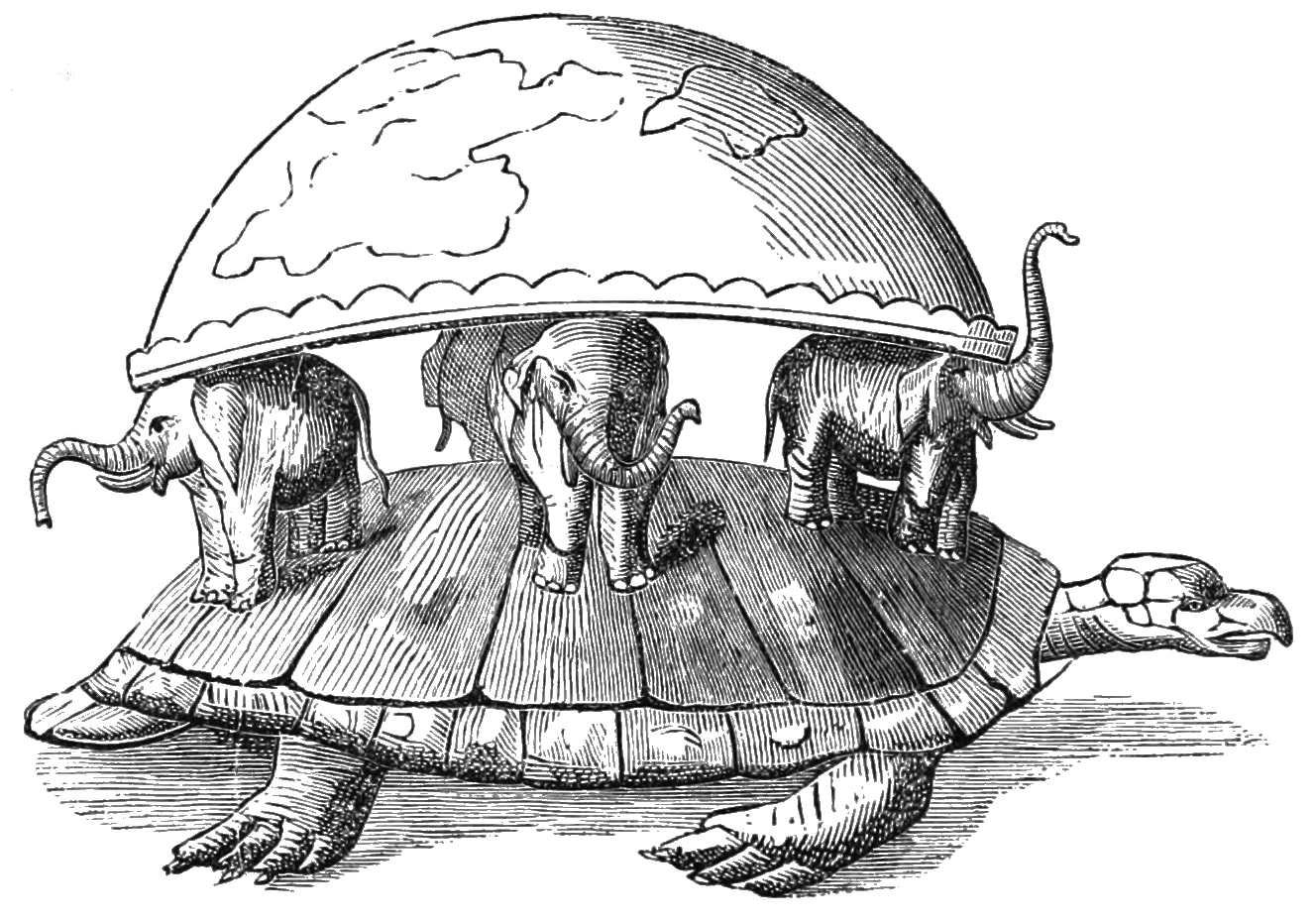
Still, all of these theories turn in on themselves, falling victim to “infinite regress.” Where did the first black hole come from? What initiated the first universe? How can something emerge from nothing? Despite all of our knowledge, we are still trapped in the same riddle as our ancestors. Some ancient cultures claimed that the universe and the world were perched atop a giant tortoise. The problem, of course, came when one asked, “What created the tortoise?” “Where is that tortoise standing?” On another tortoise? For every theory devised to explain the origin of the universe, it is “tortoises all the way down,” one tortoise, standing upon an infinite number beneath it.
Simulation Theory
We may never truly understand the origin of our universe, but we might, at least, understand how it works. Perhaps the universe is a kind of simulation? This theory, called the Simulation Hypothesis, was championed by Nick Bostrom in his 2003 paper “Are You Living in a Computer Simulation?” Drawing from our own rapid advances in computing, he suggests that future civilizations may develop the computing power to run vast numbers of ancestor simulations, making it statistically more likely that our universe exists in a simulated reality rather than the “base reality.” While unproven and perhaps unfalsifiable, the best evidence of this theory, in my view, can be found in the quantum world and the famous “double slit” experiment.
In 1801, Thomas Young aimed to challenge the then-dominant theory that visible light was a “particle” and experimentally prove it a “wave.” A “particle” can be thought of as an extremely tiny object with physical properties like volume or mass. A wave, on the other hand, is best thought of as a disturbance that travels through a medium and can transfer energy from one point to another. To prove his theory, Young shone a light through two closely spaced slits and recorded the resulting pattern that emerged on a screen behind them. As he expected, he observed an “interference pattern” of bright and dark bands of light on the screen, indicating that light was overlapping and interfering with itself, like ripples on a pond; light was not a particle, it was a wave.
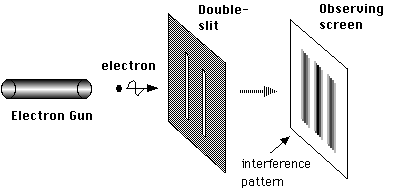
Decades later, however, the “double-slit experiment” was revisited using electrons. When a beam of electrons was fired through the slits, they too produced the same interference pattern. This didn’t make any sense; electrons were already proven to be particles. To try to understand what was going on, scientists placed sensors at the slits to measure and record the passage of electrons through them. Bizarrely, when they did this, the interference pattern on the screen disappeared; the electrons behaved as we would have expected, as particles. The double-slit experiment has been demonstrated countless times in different ways, and the results continue to mystify. If we fire just one electron, for example, it goes through both slits! However, if we place a sensor on the slits, the electron “chooses” one slit to pass through. The laws of physics appear to behave differently when we’re watching. How can that be?
One possible solution, known as the Copenhagen Interpretation, suggests that quantum particles do not have defined properties but instead exist in a state of “superposition” until they are measured or observed. When that happens, the “superposition” collapses, and the particles assume a defined state. Not everyone agrees. Physicist Erwin Schrödinger stated that it was “patently absurd” to think that observation and measurement changed the behavior of quantum particles. He illustrated this “observer paradox” through the famous Schrödinger’s Cat thought experiment. This experiment involves placing a living cat in a sealed box with a bag of radioactive material with a known 50/50 probability of decay in one hour. Also in the box, a Geiger counter connected to a hammer, and a vial of poison beneath it. If the Geiger counter detects radiation after one hour, which it will 50 percent of the time, it triggers the hammer to break the vial, killing the cat instantly. According to the Copenhagen Interpretation, until the box is opened, the cat would be in a state of superposition: simultaneously alive and dead.
The “many worlds interpretation” or MWI, first proposed by Hugh Everett in 1957, theorizes that when the box containing the cat is opened, the universe splits into two “worlds,” what we might call parallel universes today: one where the cat is alive and another where the cat is dead. Both outcomes are equally real but exist in separate realms. This theory doesn’t require superposition or a collapse of states. Instead, all possibilities are equally valid, just realized in different universes that never have contact. Under the MWI, everything that can happen does happen; there is an infinite number of parallel universes encompassing all manner of possibilities. Should this theory be correct, it also describes all possible states at all possible times. That is, in the multiverse, time doesn’t “flow.” There is one universe that describes the state of being as it is “now” and another that is virtually identical in every way, except pushed forward into the future by a second, a minute, a year, a million years, etc.
The MWI leads to some interesting possibilities. Suppose, for instance, we approach the Schrödinger Cat thought experiment from the cat’s viewpoint. The cat always has a 50/50 chance of survival. This means, from the cat’s perspective, it always lives because it emerges alive in one universe. This outcome, known as “quantum immortality,” was formulated by physicist Max Tegmark and dovetails with the “anthropic principle”, which holds that whatever needs to happen for an observer to be observing, happens. Nobody ever regrets playing a game of Russian Roulette; they only regret bringing friends. From the “survivor’s” perspective, the conditions always allowed for his or her survival, as there needed to be an “observer” of the outcome. That said, Tegmark himself does not believe this theory leads to true immortality in the literal sense, as it does not account for aging or physical decay.
Simulation theory, on the other hand, resolves the double slit experiment easily. Anyone who has played a video game understands that if you run your character to the “edge” of the map quickly enough, the game’s graphics may lag, taking a moment to render the finer details of the frontier. This happens because computer games, our mini simulations, don’t waste computing resources rendering the full details of the entire map at once; they only render what is important for the observer, in this case, the player, in that moment. If we are living in a vast simulation, perhaps it conserves computing resources by not rendering the finer details of the quantum world until we, conscious beings, try to observe them.
The Informational Universe
The Simulation Hypothesis dovetails nicely with John Archibald Wheeler’s “It from Bit” theory, which proposes that all physical entities ultimately derive their existence and properties from binary yes/no questions, like computer code. In this view, reality is informational and participatory; atoms aren’t necessarily solid “stuff” but rather stable patterns of quantum information, rendered by the underlying code that governs the universe. Wheeler was neutral on whether the code was run externally; this informational universe can be of “natural” origin. Indeed, this theory appears to cleanly resolve many of physics’ most vexing mysteries.
Wheeler points to a variant of the double slit experiment called the Delayed Choice Experiment, where scientists built a device with an incredibly fast switch that allows them to choose whether or not to measure the behavior of particles after they passed through the slits but before they hit the screen. Bizarrely, even when the choice was made to measure the particles' behavior after they had already passed through the slits, they still behaved as particles. This, of course, is conventionally impossible because it would have required the particle to know, in advance, how it would be measured. Wheeler concludes that reality is participatory; the act of questioning and recording retroactively defines what the particle did. The basic building blocks of physics, in other words, are an irreducible act, a yes-or-no question eliciting an answer, what we might call a “bit.” In the double-slit experiment, asking “which path?” forces particle-like behavior. The quantum weirdness that we perceive is only visible when we isolate these systems and ask questions carefully enough to reveal the underlying informational layer.
The reality that we perceive, therefore, might be the output of trillions upon trillions of bits registered through environmental interactions. A conscious observer isn’t necessary; only an interaction that results in a recorded output. A photon emitted from a star system and travelling through interstellar space, for example, will exist in a state of superposition until it interacts with something else. Perhaps the photon collides with a grain of dust, illuminating it and generating a small amount of heat. The dust now “knows” something about the properties of the photon, the superposition collapses, and alternative states are erased. Importantly, however, the process of erasing information is irreversible and always dissipates energy by generating heat. Computation, as it were, isn’t free, and the price that must be paid is called entropy, which we will explore in detail next.
Next in this series:
Negantropic Beings (coming soon)
Previous:

I've always believed we're living inside a black hole, and this whole thing is just perpetual...each black hole birthing another universe over and over. The James Webb findings hit different when you already hold that view lol. Too elegant to be wrong, honestly.
The problem with simulations and the matrix etc is the same one as the sniff test which Descartes so abjectly failed. In his profound arrogance he imagined that there was no objective reality and that every great vista, every great work of art, every great piece of music, the relations between energy and matter that create evolution, DNA, the germ theory of disease, nuclear energy and microwaves, every great invention and even every great witticism, were all the product of his cogitating Ego.