

Colossal Cities
Conquering the housing crisis
Risk & Progress explores risk, human progress, and your potential. My mission is to educate, inspire, and invest in concepts that promote a better future for all. Subscriptions are free. Paid subscribers gain access to the full archive and Pathways of Progress.
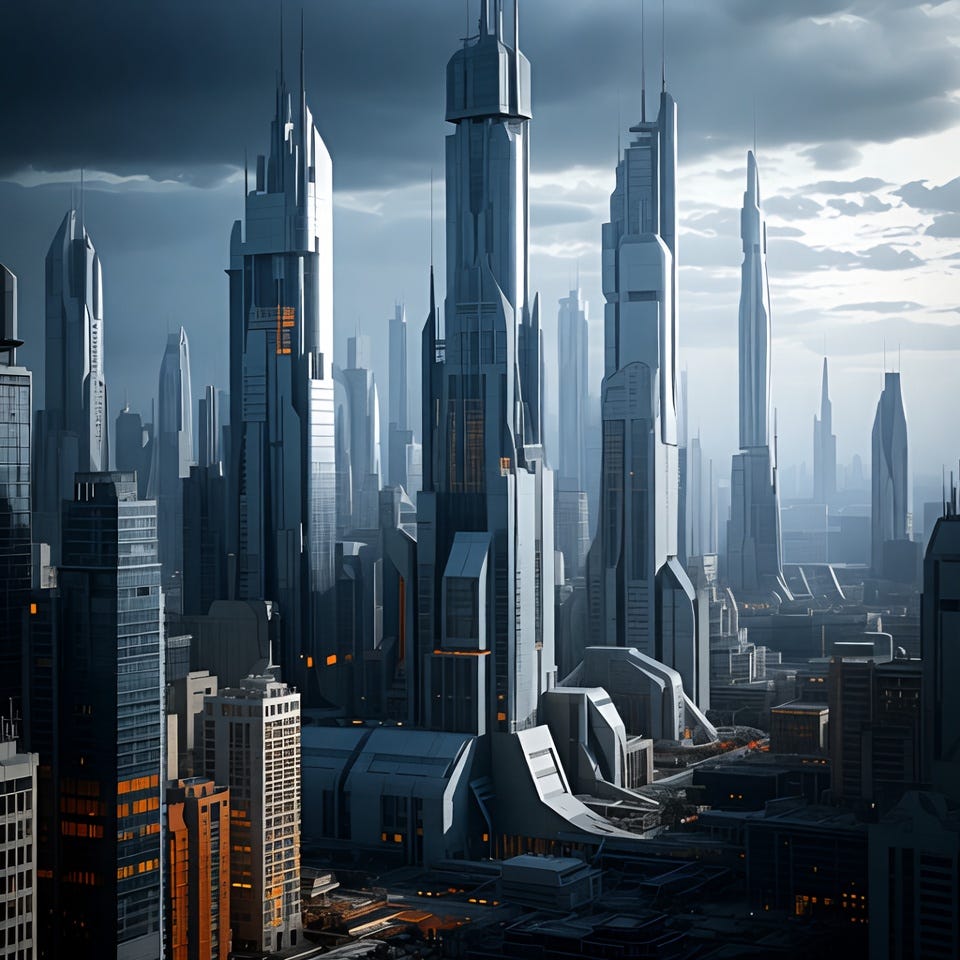
Size matters. Systems respond differently as their size, or scale, changes. These “scaling laws” create predictable and understandable patterns. In our examination of the history of human progress, we learned how all large and complex things are comprised of smaller, simpler things. We also saw how, when many smaller things combine in a symbiotic fashion, emergent properties arise: something new is created where the whole is greater than the sum of the constituent parts. Nowhere is this more true than in human cities, our cauldrons of progress. The larger our cities, the more “compute” available to our “social supercomputer.” But today, a human-engineered housing crisis stands in the way. The only solution to this crisis is to once again get comfortable with colossal cities.
Scaling Laws
In his aptly named book, Scale, Physicist Geoffrey West examines the ubiquity of scaling laws in nature. In fact, we have already discussed one scaling law: how the square-cube law dictates the maximum potential size of early single-celled organisms and why this forced life to become multicellular. But scaling laws rule over everything. Kleiber’s Law, for example, holds that when organisms double in mass, their metabolic rate increases by only about 75%, not double as logic would have it. In other words, as organisms grow larger, they become more “energy efficient,” their metabolism exhibits a kind of biological “economies of scale.” Scaling laws can also apply across time. In the mammalian kingdom, for example, all species live for an average of 1.5 billion heartbeats. Lifespans, therefore, are a function of how fast a mammal’s heart beats. A shrew’s heart, for example, beats 1000 times a minute, limiting them to a 2-3 year life.
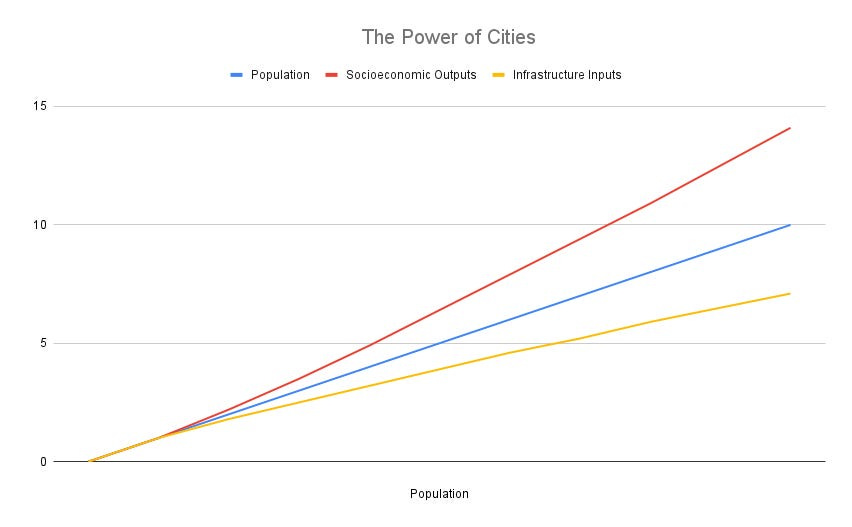
Human-created systems can also follow nature’s scaling laws, especially when they emerge organically. And what human-created systems emerge organically, you might ask? Our cities do. Our cities unconsciously arise and organize themselves like a living, breathing organism. This means that our cities scale favorably. Infrastructure, the length of roads, piping, electric lines, fiber optic cables, and even the number of gas stations, scales sublinearly with population size to the exponent of 0.85. This means the population grows faster than the total inputs required to support it. Socioeconomic output, on the other hand, such as the number of patents produced, GDP, and even average incomes, scales superlinearly to an exponent of 1.15. In other words, the larger the city, the more innovative and affluent it tends to be, making better use of human capital.
Compare, for example, a city of 100,000 and one with 1 million inhabitants. Ceteris paribus, the latter will be about 17 times more innovative than the former. A city of 5 million, with 50 times the population, will be 130 times more innovative.
This shouldn’t be at all surprising, for it explains a lot about the origins of human progress. As agricultural technology freed some of us from rural isolation, our towns began to grow. In these small-scale cities, each individual could achieve far more by working together, distributing computation through their larger social networks, than they could in small, isolated tribes or bands of hunter-gatherers. The same cognitive hardware, the same squishy pink brains that drew on cave walls, could now invent flying machines, etch microchips onto silicon, and split atoms. Indeed, the pace of everything accelerates when we congregate into cities. Commerce is conducted at a faster pace, businesses are born and die more frequently, and people even walk faster as the population rises. Diseases spread faster in cities, too, necessitating clever innovations like water treatment plants and sewage systems.
Indeed, as cities scaled larger, they were forced to overcome impediments to their continued growth. Until the Industrial Revolution, for example, most cities, including those in Europe and Asia, were surrounded by protective walls and moats. From the air, they probably even looked like bacteria on the planet’s surface, the various shops, homes, and squares resembling organelles, all protected by a semi-permeable membrane of stone. Early human cities, however, were limited to 5km in diameter. Why? Because humans walk at about 5 kph and, in accordance with Marchetti’s constant, humans allocate only up to one hour per day to traveling, therefore, 5 kph was the maximum size a walkable city could be. Only with the invention of the locomotive, trolley, bus, and car did cities begin to tear down their walls and drain their moats.
And where cities couldn’t expand outward, different innovations allowed them to expand upward. Until the 1870s, buildings were limited to about five stories in height. Aside from the fact that most people did not care to climb more than five flights of stairs, this height limitation was itself a consequence of scaling laws. As buildings rose taller, their load-bearing walls of stone or brick needed to be increasingly thick to bear the mass, consuming usable space and driving up material costs. Innovations, like Elisha Otis’s safety elevator in 1852 and steel frame construction soon after, made building beyond five stories practical for the first time. The skyscraper was born.
Housing Crisis
Alas, some measures intended to ensure that our cities remain livable as they scale have backfired badly. After the 1950s, many cities began enforcing “green belts,” rationing building permits, or adopting other measures to contain urban sprawl and ensure that our urban jungles grow upward, not outward. In his book, “Planet of Cities,” Shlomo Angel states that this “containment paradigm,” which seeks to limit urban expansion, was pushed by homeowners in concert with municipal officials and environmentalists, ostensibly to preserve nature and the environment around the urban jungle. Of course, it was also in the financial interests of existing homeowners; if new land on the urban periphery were easy to acquire, the value of existing homes would be lower.
The effects of the “Containment Paradigm” were exacerbated by the rise of Euclidean zoning. Initially well-intended, zoning rules were meant combat the negative externalities of development, to ensure, for example, that apartment residents weren’t breathing the waste of a factory smokestack across the street. As I discussed earlier, however, zoning boards quickly became captured by local homeowners who utilized them to restrict the supply of housing and raise their property values. Indeed, many of the skyscrapers you see in New York, for example, would be illegal to build today under existing rules. Many of our cities are now strangled, unable to grow upward or outward.
Yet, it is in the interest of human civilization to leverage scaling laws and allow our cities to grow, and grow big. Is it possible to balance urban habitability with the natural need for scaling? I believe so. Angel suggests that we abandon our “green belts” and “make room” for urban expansion once more. Our goal should be to restrain the median housing price to about three times the median household income in that jurisdiction. This is attainable. In 1969, for example, almost every metropolitan district in the US had a median cost-to-income ratio under 3.0, and the average was just 1.8! Getting there requires more than making room for urban expansion; however, we will also need to design a new zoning regime that can react more flexibly to demand. If and when we do this, the price of housing will gradually converge closer to its construction cost.
One alternative to Euclidean zoning has been gaining traction since the 1990s: “Form-Based Codes” or FBC. Like Euclidean Zoning, FBC attempts to prevent the negative externalities of growth and ensure that our cities remain livable as they scale. It does so, however, in a more flexible way. FBC de-emphasizes the use of land, focusing instead on the physical form of the structure built upon the land and its interaction with the surrounding city. Look at any FBC-based neighborhood, and you will notice how much more attractive, more inviting, and walkable they are compared with those built around rigid Euclidean zoning. More importantly, because they do not restrict housing density nor mandate a single exclusive use, it’s possible to build apartments/condos with convenient businesses and shops on the ground level.
Another alternative approach can be found in Japan, where there are only 12 zone types, greatly simplifying administration compared to the hundreds of zoning variants and sub-variants found in the United States and other countries. The Japanese order these zones in terms of maximum potential “nuisance,” and like FBC, might be thought of as “inclusive” rather than “exclusive,” not limited to a single use. Uniquely, these zoning laws are standardized at the national level, with local governments’ power limited only to implementation. This is crucial because it prevents zoning boards and local governments from rigging the regulations to inflate their own property prices.
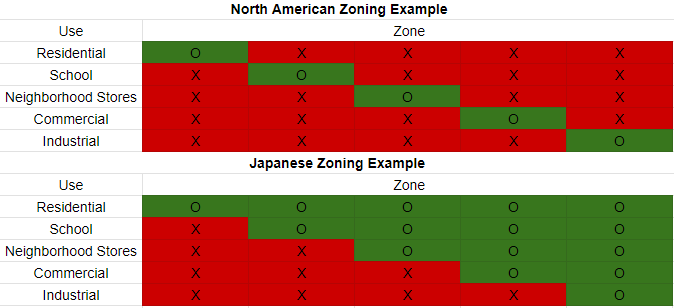
Within these zones, the maximum building size is determined by the floor-to-area ratio. Height restrictions are still present to ensure proper sunlight and ventilation, but unlike North American height restrictions, which tend to be absolute and arbitrary, Japanese rules are flexible. The maximum allowable height is determined by a formula that accounts for the setback from the road and road width. Further, Japanese residential zones do not differentiate between residence types. Residential is residential, whether it be a single-family home, duplex, or condominium. All residential building types can coexist within the same zone, allowing the housing supply to adjust to demand. Instead of having to shoehorn themselves into the existing housing stock, consumers are more likely to find a home that fits their needs and price point. As a consequence, Japanese megacities like Tokyo have remained relatively affordable compared with cities in other countries.
I must also reiterate that, ultimately, any zoning reform is best paired with an effort to replace property taxes with Land Value Tax (LVT). When shifting the tax base to include only unimproved land value, we discourage wasteful land speculation and simultaneously eliminate the “tax punishment” that accompanies all new development. Parking lots, vacant lots, and other suboptimal land uses would be replaced with higher-value housing, offices, and shops. Together, LVT and zoning reform constitute a housing policy “double helix,” each side reinforcing the other, collapsing the price of land and ensuring a robust supply of housing atop it. Together, these measures would bring an end to the housing crisis, accelerate economic growth and innovation, and allow our cities to live up to their full potential, to become truly colossal.


It's interesting how much burden we put on growth. Tucson AZ is a great example of a progressive city board having the most regressive and nostalgic policies. As a result growth is stagnant and innovation is non existent.
It wasn’t Otis’s safety brake that exploded growth upward, important though that was. It was Frank Spragues electric elevator with control system … hydraulic elevators were height limited but electric motors with steel cable were not … Otis bought his elevator company and became the world leader … and he also developed the first electric trolley and subway, leading to more expansion out … and for icing before going out on his own he first designed Edison’s electric distribution for lighting NYC
Possibly the greatest inventor who is not a household name like Bell and Edison