

Dynamos of Discovery
The case for a network of superlabs
Risk & Progress explores risk, human progress, and your potential. My mission is to educate, inspire, and invest in concepts that promote a better future for all. Subscriptions are free. Paid subscribers gain access to the full archive and Pathways of Progress.

The study of human progress is, in many ways, the study of economics. Once referred to as the “dismal science,” economics helps explain how we collectively work to raise living standards and how we fight the battle against entropy. The discipline, which now has centuries of data and experience to draw from, has a fairly well-developed understanding of growth. There has always been, however, a nagging variable, the fly in the ointment, that economists have struggled to wrap their heads around: the role of innovation. Specifically, how knowledge discovery and its diffusion help drive economic growth and human progress. This is a gaping hole in the discourse, and if we are to find ways to sustain and accelerate human progress, we should probably attempt to plug it.
The “Missing First Chapter” of Economics
Author Michael Magoon recently lamented that economists “begin halfway through the story.” Though their models are increasingly nuanced and precise in describing growth, they do not yet fully describe the origins of modern prosperity. In my attempt to understand and explain the roots of human progress, I have framed my analysis through the lens of the first principles of physics. The universe, as we understand it, is always seeking to raise total entropy, and life accelerates this process through the accumulation of knowledge. This knowledge is encoded into physical matter, from the DNA blueprints that instruct life how best to grow and reproduce, to the neurons that store information in our brains, and even etched into the silicon surfaces of modern microelectronics.
Following Magoon’s lead, let’s briefly look at the history of economic growth models and how our understanding of growth has evolved. The foundational model of growth is known as the Solow model after economist Robert Solow. The Solow model posits that economic growth arises from the expansion of three factors: labor, capital, and productivity. The faster a nation can accumulate labor and capital, the faster its economy will grow. That third factor, however, was seen as a residual, but critical. Growth is the story of doing more with less: producing more value with less energy, less matter, and less labor. This is the core of technological progress; the very essence of our counterentropic pursuits. Yet, the Solow model treats this variable as exogenous, something that ‘just happens,’ apart from the model itself. This cannot be right.
In the decades that followed, Paul Romer refined Solow’s work by treating innovation as a process that occurs within the economy. When companies and governments invest in knowledge discovery, whether through research and development labs, universities, or by funding general education and schooling, they discover new knowledge. Knowledge is non-rivalous, so the benefits of discoveries spillover to everyone and everything. This endogenous growth theory comes closer to explaining how economies grow over the long term. It still, however, leaves some factors unexplained. It oversimplifies, treating innovation as a simple, one-way, global benefit. It does not account for the harsh reality of change, that knowledge spillovers can not only create, but also destroy. That is where the Aghion–Howitt model comes in.
In their model, new ideas replace old ideas, classic Schumpeterian “creative destruction.” While we often think market actors, like businesses, compete with each other for market share, this is misleading. In reality, businesses work very hard not to directly compete; instead, they differentiate themselves, and, if successful in the market, grow and expand. It’s just “evolution’s algorithm” again: differentiate, select, and amplify. Differentiation means innovating; seizing first-mover advantage and the temporary economic rents that it confers. Patents, a temporary right to exclude others from an idea, can aid this process, though strong IP law can cause more harm than benefit (we will examine this soon). The Aghion–Howitt model suggests that while the government cannot create progress, it can set the table by creating optimal conditions for knowledge discovery and diffusion.

Here, the steel-reinforced academic silos of economics and physics collapse onto one another. Knowledge discovery, the pursuit of economic “rents,” mirrors the process through which life on Earth raises entropy. We discussed earlier how life, tiny pockets of order, accelerate the dissipation of energy in accordance with the second law of thermodynamics. In creating beneficial counter-entropic forms, the economic system does the same; competition creates small pockets of rents, and the subsequent spillovers (the diffusion of knowledge) raise the productive output of the entire system over time. These economic rents, these pockets of order, are temporary and fleeting, just as life is. Think of this process as akin to what happens when you crack open a cold can of soda and pour it into a glass. Seemingly out of nowhere, bubbles, pockets of order, pop into existence, growing larger as they rise, bumping into other bubbles along the way, sometimes merging with them, until they reach the surface and cease to exist.
This parallel, between the economy and entropy, is no accident; it’s the same process, just labeled differently by the professionals in their respective fields. Thus, returning to our discussion of the “missing first chapter” of economics, I suggest that the conditions that give rise to economic growth, the kind now mathematically described by economists, have their origin in the second law of thermodynamics. This also means that the conditions that gave rise to modern prosperity, including forms of government, cultural norms, and institutions, emerged from the same “algorithm” of trial and error that life uses to create order from disorder, all in service to basic principles of physics.
What Role Can the Sovereign Play?
This, of course, raises the question: can we accelerate the accumulation and diffusion of knowledge? In their book, Creating a Learning Society, Joseph E. Stiglitz and Bruce C. Greenwald argue that a society’s ability to learn and spread what it has learned is central to raising living standards. They recognize that the social returns to discovery vastly exceed the private returns and that there are natural limits to the rate of knowledge diffusion. In pursuit of rents, for example, firms work to keep knowledge within their walls, requiring non-compete or non-disclosure agreements with former employees, and/or treating their IP as a trade secret. Countries work to keep some knowledge to themselves, particularly when it comes to weaponry, while language and cultural barriers also impede diffusion. This means that, absent some sovereign intervention, there is a natural underinvestment in knowledge discovery, and diffusion is not instantaneous.
Stiglitz and Greenwald argue that economists typically focus on maximizing static efficiency, optimizing for growth by minimizing economic distortions as they exist today, which distracts from potential dynamic benefits over time, particularly as it relates to the creation and diffusion of knowledge. Some investments, especially in manufacturing, where experience curve effects are most pronounced, are worth fostering for the spillover effects they engender, even at the cost of reduced, short-term, static efficiency. Thus, countries that prioritize sectors with high growth curves will move up the development ladder more quickly than those that take a pure laissez-faire approach. That is, Stiglitz and Greenwald propose a kind of industrial policy, particularly in emerging economies, targeted at the manufacturing sector.
This sounds a lot like the “infant industry” argument, that governments should protect and/or promote domestic producers until they “grow up,” but this isn’t quite accurate. Stiglitz and Greenwald admit that governments are poorly equipped to “pick winners” in the market and often inadvertently “pick losers” at an extraordinary cost. Instead, they propose what might better be termed an “infant economy” argument, where the government doesn’t promote any one particular product or industry, but rather seeks to foster learning as a whole, with a particular focus on the industrial sector where experience curve effects are greatest. The broader lesson we might draw here, however, is that we should judge policies not by their ability to promote pure economic efficiency, but by their ability to foster accelerated knowledge accumulation and diffusion.
It may be argued that the best practitioners of this approach are found in East Asia, including Japan, South Korea, and China. All have used a combination of measures, including (at least initially) weak IP laws, heavy investment in education, promotion of the sciences, technology transfers, artificially low currency exchange rates, and domestic subsidies, to foster domestic learning spillovers. Often, this results in the creation of “national champions,” from Japan’s keiretsu firms, to Korea’s Chaebols, to China’s SOEs and private firms like Huawei. Conventional economic thinking would hold that directing resources to “national champions” is inefficient, a drag on the economy, and it is, in the static sense. The success of these economies, however, suggests that the learning spillovers may be worth the cost.
Building the Science State
I do not necessarily agree with the economic prescriptions made by Stiglitz and Greenwald. I do, however, acknowledge the value of knowledge discovery, diffusion, and the free market’s natural limits in fostering this process. The sovereign has a role to play, even if that role should be deliberate and limited. The aim is to strike that delicate balance between pure short-term economic efficiency and long-term knowledge accumulation. Where the free market fails us, we must turn to the Leviathan for assistance. Only the sovereign is in a position to create a culture of innovation and develop a true discovery ecosystem.
One of the best models of innovation, known as the “Triple Helix Model,” recognizes the role of the sovereign. First proposed in the 1990s, the triple helix model suggests that symbiotic interactions between industry, government, and universities give rise to new intermediary institutions, such as science parks and technology transfer offices (TTOs), that create a culture of discovery. In this model, all three players retain their core roles but also assume some of the other's functions. In his book, “Knowledge and Competitive Advantage”, Johann Peter Murmann credits the rise and dominance of the German synthetic dye industry to the cross-fertilization of people and ideas between research universities and industry. The universities provided a steady stream of new talent for the dye industry, while experienced industry chemists often returned to academia to teach and research. The stronger these ties, the more competitive the firms became.
Crucially, German success was aided by the government. In the late 19th century, the German scientific higher education system produced far more talent than its British counterparts, in part because the German state was more willing to subsidize it. Per institution, state subsidies were 5-10 times higher in Germany than in Britain. The triple helix model, however, is perhaps best epitomized in “Silicon Valley,” which emerged when the double helices of industry-government and government-university converged. Government contracts for radio and microwave technology initially supported the valley’s nascent electronics industry. When this industry began interacting with Stanford University, however, it produced the semiconductor mecca we know today, single-handedly igniting the “second machine age.”

Visual depictions of the “triple helix” often feature a static image of three overlapping circles, which represent the interaction between the players. In reality, these interactions are fluid and therein lies the power. Recall that for an idea to become an innovation, it must try its hand in the marketplace. The triple helix can adapt to the changing needs of a venture’s lifecycle as the idea it promotes evolves into a full-fledged innovation. Freeman and Engel’s model of an entrepreneurial venture divides this lifecycle into four stages. First is “inception,” where the focus is on developing a business plan and securing funding. Second, in the “launch” phase, the business begins operating and generating revenue, though typically at a loss. This stage is often referred to as the “Valley of Death” for most startups. If it survives, the venture enters the “growth” stage, finally becoming cash flow positive. And lastly, the “maturity” stage, where institutional investors take their profits through an IPO, a merger, or an acquisition.
Governments can help their firms through the “Valley of Death,” and they often do, using tax incentives. The literature suggests that tax incentives induce more private R&D spending, with one study concluding that a 1 percent fall in the after-tax cost of R&D results in at least a 1 percent increase in R&D spending. At the very minimum, the tax code should allow the full and immediate deduction of R&D expenses. Some countries go further, offering a “super deduction” for R&D. While this is a powerful incentive for companies to conduct more research, it’s also an incentive to relabel normal expenditures as “R&D” for tax benefits. Regardless, I have advocated for the total abolition of the corporate income tax and capital gains tax anyway, which would free up productive capital that would otherwise be taxed away.
The sovereign still has other levers it can pull, however, in its mission to promote the discovery and dissemination of knowledge. Many universities already have established technology transfer offices (TTOs) that license university-developed IP for profit. Others have chartered separate entities to handle their IP, including forming start-ups to commercialize new ideas. Some universities have evolved functions once limited to business incubators, including legal/managerial advice, office space, and access to university facilities. The government can help expand the process with direct research funding, and as we will soon discuss, the promotion of income-sharing agreements that can cultivate a closer relationship between industry and academia.
Admittedly, sovereign direct research funding has a mixed track record, but we don’t need to look far to find some examples of success. As Mariana Mazzucato writes in her book, The Entrepreneurial State, many modern technologies began with government-funded research. The smartphone in your pocket, for instance, is powered by Lithium batteries, which can trace their roots to research at the US Department of Energy. The microchip inside the device arose from an industry that was supported in infancy by the US Defense Department and NASA, as was GPS, a government-funded satellite network originally built for national defense. Some disagree with Mazzucato’s conclusion that the state can be an effective innovation incubator, arguing that she cherry-picks a few successes among a graveyard of failures.
Indeed, it’s unclear if the government can reliably choose which ideas to nurture. In the late 1970s, America, for example, computer hobbyists invented the first desktop computers, kickstarting the PC era and an entirely new industry. Around that time, the Soviet Union also had garage tinkerers, but in the command economy, they were unable to tap VC funding or start a business; they had to seek bureaucratic support instead. Like many at the time, bureaucrats could not see the value in a personal computer and refused funding. As a consequence, the computing industry took off in America and stagnated in the USSR.
Still, this doesn’t mean that the government has no role to play, especially when its role is limited to general funding. Research suggests that a 1 percent increase in publicly funded R&D generates a 0.4 percent “crowd-in” of private R&D spending, and the ROI for government-funded research is overwhelmingly positive. An analysis by Matt Clancy, estimates that the pure ROI is about $5.50 for every $1.00 spent. When factoring in non-monetary benefits, including knowledge spillovers, however, the ROI could easily double to $11.00 for every $1.00 spent. After five years, a 1% increase in government R&D spending leads to a 0.025% increase in economic productivity. While harder to estimate, the marginal ROI on government spending is also positive. Azoulay et al., for example, estimate that every $1.00 in additional research funding through the NIH leads to $2.00-$3.00 in new pharmaceutical sales, and most studies measuring the marginal ROI suggest that every $1.00 in spending yields between $2.00 and $5.00 in economic benefits.
The question, therefore, is not whether government funding can be a net positive, but how to use those dollars most effectively. One model worth exploring is the Defense Advanced Research Projects Agency, or DARPA, which has led to breakthroughs in stealth technology, autonomous driving, robotics, etc. DARPA has done this with a staff of approximately 120 individuals and a small annual budget of just $3.5 billion. DARPA has been uniquely effective because the agency adheres religiously to a few principles: 1) Ambitious goals, 2) Temporary teams, 3) Political independence, 4) Acceptance of failure, and 5) A dedication to Pasteur’s Quadrant. DARPA’s ambitious goals attract the best and brightest from all walks of industry and academia, bringing together diverse talent. The transitory nature of those teams, typically 3 to 5 years, creates a sense of urgency that accelerates progress while DARPA’s independence and flat organizational structure enable the agency to select and cancel projects at will.
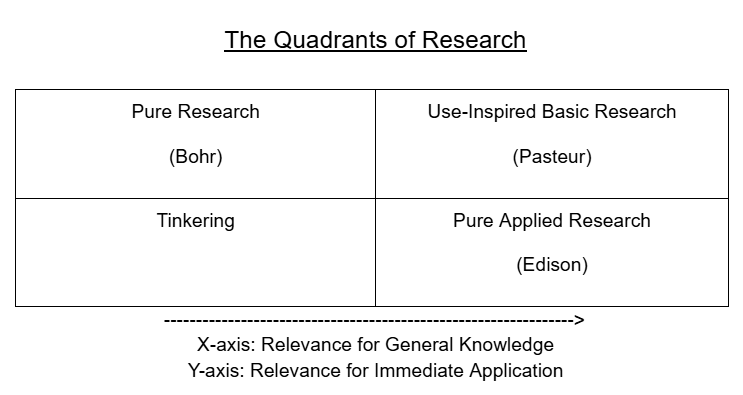
Most importantly, however, DARPA’s research is dedicated to Pasteur’s Quadrant. Typically, research funding is allocated by intent, with some directed to “applied science,” or research aimed solely at practical uses, and some going toward “basic science,” or the pure quest for fundamental understanding. However, as Donald Stokes opines in his book, Pasteur’s Quadrant, this is a misleading dichotomy. Rather than being opposed to one another, basic and applied science are orthogonal, and the bridge between them is Pasteur’s Quadrant. The quadrant is named after Louis Pasteur, a scientist who exemplified both the quest for knowledge and its practical applications.
Discover Hubs, the Superlabs
In recognition of all of the above, and in our mission to accelerate progress, I propose establishing “Discovery Hubs” or “superlabs,” where the government partners with academic research departments, generously funding them with a focus on Pasteur’s Quadrant, straddling the fine line between “wasteful” exploratory research and “applied” science. The universities would then be free to form new ventures to commercialize the discoveries. Alternatively, because they would already be working closely with industry players through income-sharing agreements, they could also sell or transfer the fruits of discovery to their partners.
This would not, obviously, be an effort to maximize pure economic efficiency, but a means of cultivating talent, promoting discovery, and fostering innovation through a symbiotic industry/government/academia partnership. The labs would be engaged in accelerating innovation, the lifeblood of progress, and fostering the positive spillovers that discovery entails. Done right, government funding for education and science is not an expense to be avoided but an investment that only the Leviathan is positioned to make. Indeed, through a national network of Discovery Hubs, we can leverage the triple helix, accelerate the accumulation of knowledge, and speed the diffusion of that knowledge for the betterment of humankind.
Next in this series….

Previous:
Community Learning Hubs (Coming Soon)
I think there’s also a deep connection here between zero-sumness and positive-sumness in thermodynamics and politics.
Existence is inherently zero sum — the Pauli Exclusion Principle says two particles cannot occupy the same space. And the natural world is mostly full of this — two monkeys cannot eat the same banana.
But entropy allows us to create a bubble of positive-sumness. Two humans can cooperate and grow more bananas! It’s not infinite, but there’s a LOT of progress to be had.
I think this trickles up to systems of voting and power: systems that have only one winner ultimately lead to cycles of zero-sum domination. The best, most progressive, most resilient systems find ways for there to be multiple winners.
This is exactly the kind of content I hope to get by following you. You explain succinctly and factually, with no agenda. I read quite a lot about growth and progress, but I keep on learning from people like you.
The state-backed research model applies only to advanced economies and in particular to the USA, which has a very science-friendly regulatory culture. Similar research hubs don't work in the UK, thanks to the Slough of Despond created by bureaucrats. In developing countries, research hubs don't work at all. As soon as the researchers have enough knowledge and skills, they are off to the fleshpots of the West for ten times the pay. The most important thing for a developing country is for government to get the hell out of the way.