

Reality, Distorted
In a world of wonders, why are we so gloomy?
Risk & Progress explores risk, human progress, and your potential. My mission is to educate, inspire, and invest in concepts that promote a better future for all. Subscriptions are free. Paid subscribers gain access to the full archive and Pathways of Progress.
The data are unequivocal: life is better today for billions of people than at any time in human history. We are better educated, live longer, enjoy higher incomes, and possess more freedoms than our ancestors could have imagined. Yet when asked to compare the present to the past, most people believe the opposite. In their minds, the world is growing poorer, hungrier, and less able to meet basic human needs. The gap between reality and perception is no accident. The forces driving progress often defy our evolutionary instincts, which are wired for vigilance, scarcity, and threat detection. The result is a pervasive reality distortion field that doesn’t just mislead us; it endangers progress itself by turning public opinion against the factors that sustain it.
The Four Horsemen of Reality Distortion
Many social theories are based on the premise that people are rational decision-makers; that we are all “econs,” carefully weighing our choices with perfect information at all times. Alas, we are “humans,” not “econs.” We have the capacity to reason, but we don’t as often as we should. In his book, “Thinking Fast and Slow,” Daniel Kahneman argues that the human brain comprises two distinct thinking systems. The first, called System 1, operates automatically and quickly, relying on intuition and mental heuristics/shortcuts. System 2, on the other hand, is responsible for thoughts that require our active attention, including reasoning through complex problems. But because the latter uses more mental bandwidth, our brains rely on the former whenever possible. This, however, leaves us susceptible to many cognitive errors, biases, and fallacies. The four most treacherous of which are: nostalgia, negativity, availability, and zero-sum bias.
You have probably heard someone say the phrase, “the good old days,” used to imply that the state of affairs in the past was better than in the present. This is an example of nostalgia bias, which features prominently in the study of human progress. The problem for us is that we often cannot trust our own memories; our brains have built-in mechanisms that suppress negative memories over time. Thus, the past will almost always be remembered more fondly than it probably deserves. Case in point, a viral “meme” circulating online features an illustrated image of the “typical” American family circa 1960: a stay-at-home mother, a kid going to college, a house, and a car, all affordable on the income of the sole male breadwinner. The meme’s characters are content and happy, typical of a time that was better, simpler, and more wholesome.
The world this meme portrays, however, exists only in our memories. The notion that two American incomes are now needed to afford the quality of life as depicted in the meme is patently false. In 1960, the car ownership rate in America was half of what it is today (2023). The average new home was about 25 percent smaller, lacked basic amenities like garbage disposals, dishwashers, fire alarms, etc, and most people lived in older, smaller homes that also lacked air conditioning and washing machines. A university education is certainly more expensive today than it was then, but children in the 1960s would likely not have attended. The fact is, a family today can certainly live on a single income, so long as that family is content living as the average one did in 1960. That means owning only one car, a small home, one television with three channels, taking road trips instead of flying, etc. In fact, that family would live better today, because they would have access to modern medicine, cheaper clothing, cheaper food, and their car and home would be vastly safer, more energy efficient, and have features that would have been unimaginable luxuries in 1960.
Our perception of reality is further distorted by the fact that while our brains suppress negative memories and feelings over the long term, they amplify them in the moment. This phenomenon, known as negativity bias, has been demonstrated countless times in studies conducted across the globe. Like flies drawn to a lightbulb, we give extra attention and more emotional weight to negative information. This is probably an evolutionary artifact; our ancestors benefited more from quickly noticing threats than opportunities. In one experiment conducted in Canada, for example, participants were told to read a newspaper article while they “waited for the experiment to begin.” Researchers then watched which news articles the unknowing test subjects chose to read. Consistently, they sought out negative stories rather than positive or neutral ones.
Negativity bias is closely related to another innate cognitive quirk: loss aversion. Humans place greater emotional weight on losses than they do on gains or wins. Studies have shown that winning $10, for example, produces a smaller emotional response than losing $10, even if the financial impact is exactly the same. Negativity bias is the cornerstone of the media industrial complex, from social media to the 24-hour news cycle. To keep us glued to the television or engaged online, media outlets and influencers intentionally flood the airwaves and feeds with negativity, leveraging this ingrained biological attention reaction for their benefit. This is why a country amid a bloody civil war will draw news correspondents while a country prospering in peace does not.
Loss aversion and negativity bias dovetail with a related cognitive error, known as the “availability heuristic” or “availability bias,” where our brains rely on immediate examples to inform decisions involving the probability of events. Deaths caused by horrific accidents, homicide, or wars, the type of tragic negative information that gets reported and amplified in the media, for instance, are erroneously seen as more probable than deaths by diabetes or a poor diet. Horrific accidents and tragic events draw more eyeballs, triggering more reporting, more sharing, and thus are more “available” than they otherwise should be. The consequence is that we miscalculate risks; billions of dollars are spent countering terrorism, for instance, but the risk of dying at the hands of a terrorist is extremely low. We would be better off spending that money combating heart disease, lightning strikes, car accidents, or even falling coconuts.
Nostalgia, negativity, and the availability bias conspire to distort how we perceive reality. When our brains compare the past with the present, our minds convince us that the present is terrible and full of danger and then contrasts this characterization with a rose-colored version of the past, creating the illusion of a downward trajectory. This is a shame. In 2016, for instance, Dutch researchers asked 26,492 participants how global poverty had changed over the prior 20 years. Incredibly, only 9 percent of respondents correctly answered that poverty had plunged by over 50 percent. This is even more shocking when we realize that it was a multiple-choice test with a 20 percent chance that a respondent could have guessed the correct answer!
Zero-Sum Bias
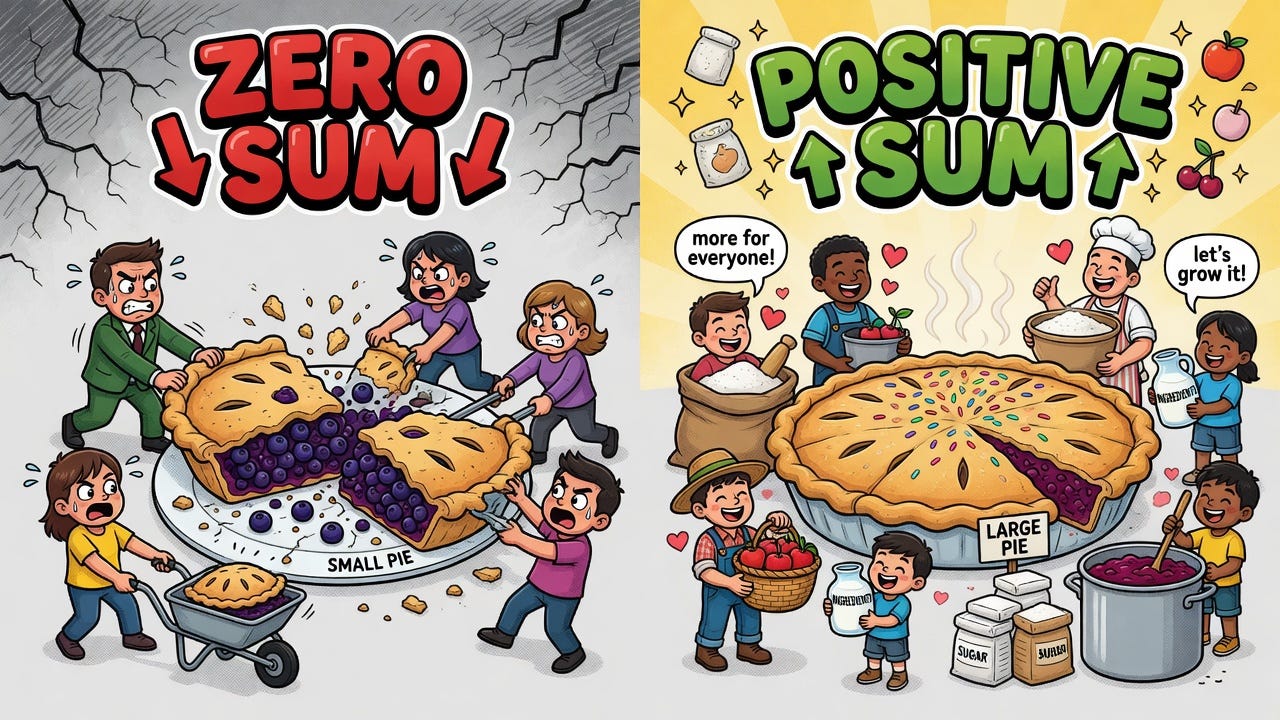
Perhaps the most pernicious cognitive bias, however, is our propensity to subscribe to “zero-sum” thinking. We innately perceive opportunities and resources as fixed in number; therefore, for me to “win,” you must “lose,” and vice versa. Zero-sumness appeals to our base instincts because it requires only low-effort “System 1” type thinking. Once we engage our System 2 reasoning, however, this “logic” falls flat. Zero-sum thinking is most prevalent when discussing global trade, wealth, or immigration. In trade, zero-sum bias leads us to falsely believe that the “loser” incurs a “deficit” and the “winner” a “surplus,” but this is generally false. In free markets, transactions only take place to the extent that both parties “win.” Trade, as we will discuss, is positive-sum: trade broadens competition, compresses prices, and jump-starts innovation. The same is true for wealth accumulation; Jeff Bezos’s billions do not make you poorer. Wealth is created, not hoarded.
Zero-sum bias also plays a significant role in the discourse surrounding immigration or global migration. The arrival of immigrants from abroad, we assume, must “steal” or “take” jobs from the “native” population. Economists, however, have long understood this notion to be false. So false, in fact, they even have a term for it: the Lump of Labor Fallacy. More immigrants do engender more competition for jobs; that much is true. But the arrival of more consumers and taxpayers from abroad also raises the demand for jobs as well. The net effect of immigration on jobs or wages is minimal in the short term, but, as we will also discuss, largely net positive in the long term for the receiving nation.
Zero-sum thinking also drives Malthusianism, the belief that population/economic growth inevitably leads to resource depletion as more people clamor for scarce resources. Indeed, Malthusianism is so attractive that many of the world's brightest minds, even today, are taken in by it. Malthusian zero-sum thinking always leads to the same conclusion: to save humanity or the environment, it is imperative to halt and reverse progress, growth, and our population. As we will see, history has repeatedly shown this to be mistaken. Growth is positive sum. Technological progress allows us to do more with less. We grow more food using less land, we produce more goods with fewer people, our cars drive further with less gasoline, our fuels create less pollution with more energy, etc.
Contrary to Malthusian fears, as the human population grew, the availability of resources also grew. In fact, resource abundance has grown faster than the population itself, a concept that Marian L Tupy and Gale Pooley call “Superabundance.” The more mouths we needed to feed, counterintuitively, the more abundant food became. Nor did economic growth necessarily imply more pollution or environmental degradation. In the wealthiest of nations, forest coverage is spreading, smog is clearing, climate-changing CO2 emissions are falling, and the consumption of key commodities is receding. We don’t have to choose between the planet and our pocketbook: we can have both!
Reality, Undistorted
Alas, it’s an uphill battle to convince most people that the world is getting greener, resources are becoming more abundant, or that poverty is lower. I, too, long fell victim to these cognitive errors and biases. It took me years of reading, tirelessly poring through data to “deprogram,” to understand that reality was distorted by my own cognitive lenses, my own “reality distortion field,” albeit one collectively shared by most people on Earth. Its difficult to deprogram others, in part, because of another cognitive quirk: “confirmation bias.” Because we work hard not to engage System 2 reasoning, most of us don’t expend the necessary cognitive resources to impartially evaluate data and arrive at objective conclusions. Instead, we choose what we believe first and “prove it” afterward by seeking only the information that “confirms” our beliefs. Confirmation bias keeps us locked in; obliged to seek out only information that confirms what we already believe.
In this process, we often convince ourselves of untruths. This is another reason that television “news” is so unreliable. Networks try not to compete directly; instead, they target the confirmation bias of a particular group, feeding that group what it wants to hear to keep its members engaged. They don’t “report the news” with objective analysis; they only confirm their viewers’ pre-established perspectives. What I seek to do here is different. By honing hard truths and swimming against the current, I aim to pop the filter bubbles, to seek only the truth in its purest form, no matter where it leads. This means putting some corrective lenses over the distortion, so that we can, for the first time, clearly see where humanity and progress came from, and perhaps where we are going. As you continue to to read this series, my only ask is that you keep an open mind and that together we remain cognisant of our cognitive limitations and biases, lest we fall victim to them.
Next in this series:

Previous:

A very thought provoking read! While I would certainly agree with your statement on how the brains has a built-in-mechanism to suppress negative memories over time and thus the past will almost always be remembered fondly than it deserves, I would add that the US was a nation that was on the rise post WW2, compared to the other nations when it came to education, military strength, technological innovation, industrial production, etc. There is no doubt that that the human race has progressed over the course of this time, US specifically has been in a state of decline, as government spending and debt have reached new levels and productivity growth has slowed. At the same time, there are emerging nations that are quietly yet quickly catching up, which has weakened the US's negotiating power at a global scale. Unfortunately, one of the undesired natural side effects of capitalism is inequality, and if over a period of time, the government does not work in unison with companies to build the right infrastructure in place to equip people and societies with jobs and other resources, negative sentiment is bound to take hold. I think, that is a driving factor today in many of America's societies that have been left behind, though as a whole human society and the race has progressed further.
Nice article. One thing that I would add is that Americans defined as “poor” in 2023 have far fewer material possessions than the median person did in 1960 (or 1970 for that matter).
An unfortunate side effect of progress is that we keep ratcheting up the definition of what it is to be “poor”.